
Stories …
… a humble schematic of – in particular – fantastic storytelling

Hello, I wish you a great day full of fantastic experiences.
Stories are one of the oldest forms of cultural heritage in humanity. People may have been telling stories long before the first melody was whistled or the first statuette was carved. Even if not, storytelling probably dates back to the same period as the cultures that created them. The word “story” is derived from Greek “histōr”: knowing, learned. Somewhere along the development of Middle English “historia”, meaning “an account of events”, branched into history and story, the latter meaning narrative, especially fictional narratives. This is neatly captured in the dual nature of the German word pair “Geschichte” and “Geschichten”: “Geschichte”, singular, refers to real past events—at least that is its claim. “Geschichte” in the singular appears in terms such as “Erdgeschichte”, i.e. the history of the Earth, or “Menschheitsgeschichte, i.e. history of mankind. “Geschichten” in the plural, on the other hand, are stories, i.e. usually fictional accounts or at least significantly embellished with invented elements.
Most of us will be familiar with this from our own childhood experiences of telling each other things on the playground or in the schoolyard: what we experienced the other day, in the previous week, or on a recent holiday with our parents. I assume that many of us have woven a few not-entirely-accurate details into essentially true events, which made our accounts a little more interesting. (I admit to being guilty of this.) In any case, stories have probably always been created in a comparable way, and that’s what stories still are: constructs with a kernel of truth, enriched with fiction and fantasies that emphasize the point the story is meant to convey or achieve. (See Weinreich 2012 for a detailed discussion of fantastical stories and their relation to reality.) This has led to realistic, scalpel-sharp social critiques from authors such as Fyodor Dostoevsky, as well as surreal, apocalyptic exaggerations from authors such as Stephen King. But beware: these exaggerations display no less analytical acuity than the realism of high culture, which is honoured with Nobel Prizes in Literature.
Evolution
Storytelling and its traditions have evolved continuously from the Stone Age to the present day, and the Fantastic has been an integral part of this tradition from the beginning. Why? Probably for two reasons: The Fantastic is entertaining, but more importantly, its exaggerations illustrate and reinforce what the storytellers want to express in the most striking way. This is true even though the audience for these stories is well aware that they are fantasies. Originally, people believed many fantastical stories, especially myths, but they must have at least some suspicions that quite some things in saga were well-crafted fiction. Atlas carrying the vault of heaven? Midas’s touch turns stone to gold? There must have been some scepticism about that, but even if – people were thoroughly entertained, which made listening worthwhile in any case. The fact that Midas nearly starved to death because even his bread turned to gold likely also prompted reflection on the true value of money and thus might have been enlightening. As King says, stories “fulfill the primary duty of literature – to tell us the truth about ourselves by telling us lies about people who never existed” (307).
In the following brief overview of the structure of stories, especially fantastical ones, I present a classification that serves as a prelude to a three-part Substack series on the precursors of modern fantastic literature and art. These will be published successively in the coming weeks, discussing Myth, Sagas and Fairy Tales. You can find previously published Substacks of mine on Fantasy, Science Fiction, and Horror here. I’ve outlined my general thoughts on the meaning, limits, and possibilities of genre classifications in two previous Substack posts here and here.
A Schematic
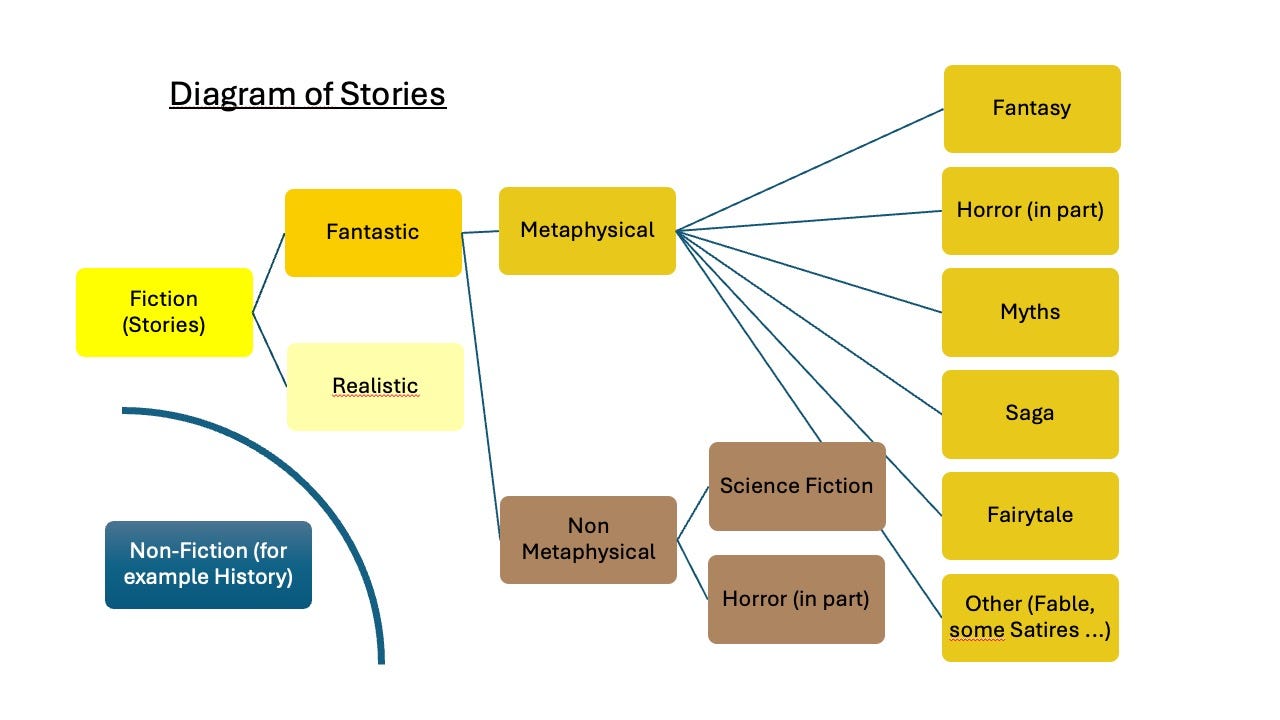
The panorama of stories can be explained in its broadest yet meaningful form according to the diagram shown below. At first and before discussing storytelling, fiction must be distinguished from non-fiction, i.e. history from stories. Fiction is then divided into the fantastical and the realistic. The next logical approach is to distinguish between works of the Fantastic containing metaphysical elements, i.e. the supernatural, and those that do not. Within metaphysical fantastic literature and art, the most important subgenres can then be classified based on their thematic and structural characteristics. This is then followed by a veritable menagerie of sub-subgenres, which seem to be growing by the day. But that’s material for Substacks I haven’t even planned yet.
What’s particularly interesting here is that all these genres are related and can be connected by tracing their historical development. This takes us from familiar territory from our education, such as the Iliad, the Odyssey, and the Legend of Artus, through the Middle Ages and the Modern Era to the Romantic period—think of Chaucer, Shakespeare, Milton, and Lord Byron—onwards to stories of today that are perhaps less familiar to you, especially if you have little or no interest in the Fantastic. These stories have found their way into the cultural memory of virtually the entire world, so you are likely already familiar with their names: “The Lord of the Rings”, “Dune”, “Star Trek”, and “Star Wars”, among others. But make no mistake, these modern stories draw on the ancient material mentioned above, reworking it and retelling its essence in new ways. This has helped both the old and new material achieve enormous popularity.
You don’t even have to read these stories or watch the films – their key messages and characteristics are presented time and again in excerpts in the press, on video platforms, on TV and via streaming. They have seeped into the conscious and subconscious minds of everyone who hasn’t spent the last twenty years on a deserted island without satellite reception. However, Memes and snippets will never allow you to tap into the full potential of the Fantastic.
While reading the books, enjoying original films, graphic novels, and video games, and then perhaps discussing them in smaller or larger circles (The Tolkien Society!), a picture emerges that Memes and Reels can only hint at. Yet, even if you have come to the conclusion based on some products that this is strange stuff and even rubbish or nonsense, you should give the Fantastic another chance. You’ll find trash in every genre. But just think of Goethe’s Faust and its profound impact on reflections about life, death and the fulfilment of desires. That, too, is fantastic literature, and the genre is still capable of that. The Fantastic has always explored themes such as those in Marlowe’s “Tragical History of Doctor Faustus”, as well as the meaning of life and much more besides. The Fantastic—at times is high literature indeed.
Stories in History
The best way to approach an understanding of the development of the Fantastic is to examine its chronology. Following it through the centuries, one will see how one genre develops out of and into another. Furthermore, examining the historical context reveals why these genres emerged and what their respective audiences took from the stories, and still do today. This is especially true when classic themes—and these are the topics that touch people’s minds and hearts—are taken up by new generations and retold in their own language and imagery for their peers. This is precisely what Fantasy, Science Fiction and Horror achieve.
The journey towards modern fantastic literature and art begins at the dawn of human history, and leads us all the way back to prehistoric times. Through archaeological findings, Stone Age cave paintings and the earliest written records of traditions that were already ancient when they were passed down orally in antiquity, we know that myth lies at the origin of all storytelling.
That’s what I’ll be exploring in a fortnight or so. So stay tuned! All the best 😀
Literature:
King, Stephen: Danse Macabre. London: Hodder & Stoughton. 2006.
Weinreich, Frank: Die Phantastik ist nicht phantastisch. Zum Verhältnis von Realität und Phantastik. In: L. Schmeink, H.-H. Müller: Fremde Welten. Wege und Räume der Fantastik im 21. Jahrhundert. Berlin, Boston 2012.19-36. Eine Onlineversion des Beitrags findet sich auf acdemia.edu: https://www.academia.edu/22431467/Die_Phantastik_ist_nicht_phantastisch_Zum_Verh%C3%A4ltnis_von_Phantastik_und_Realit%C3%A4t